
Customer Support at Scale: How Small Businesses Can Deliver Enterprise-Level Service
You've built something worth buying. Customers are coming in, and that's exactly the problem.
Every inquiry, complaint, follow-up, and "just a quick question" email that lands in your inbox is a sign that your business is alive. But when the volume starts to creep up and response times start to slip, you face a fork in the road that trips up a lot of small business owners: Do you hire a full team you can barely afford, or do you let service quality quietly decline while you handle everything yourself?
There's a third option, and it's the one enterprise companies figured out a long time ago. The difference is, you don't need their budget to do it. What you need is a system.
This guide is for business owners who want to stop playing defense with customer support and start building something that actually scales.
Why Customer Support is a Growth Lever, Not Just a Cost Center
Most small business owners treat customer support as a necessary expense, a reactive function that absorbs complaints and answers questions. That framing costs you money.
According to research by Salesforce, 89% of consumers are more likely to make another purchase after a positive customer service experience. On the flip side, a single unresolved complaint can ripple across review platforms, social media, and word-of-mouth in ways that advertising budgets can't easily undo.
Here's what enterprise companies understand that small businesses often don't: customer support is one of the highest-leverage touchpoints you have. Every interaction is an opportunity to reinforce trust, upsell a relevant product or service, collect actionable feedback, and turn a one-time buyer into a loyal advocate.
When you reframe support as a growth function, the investment calculus changes entirely.
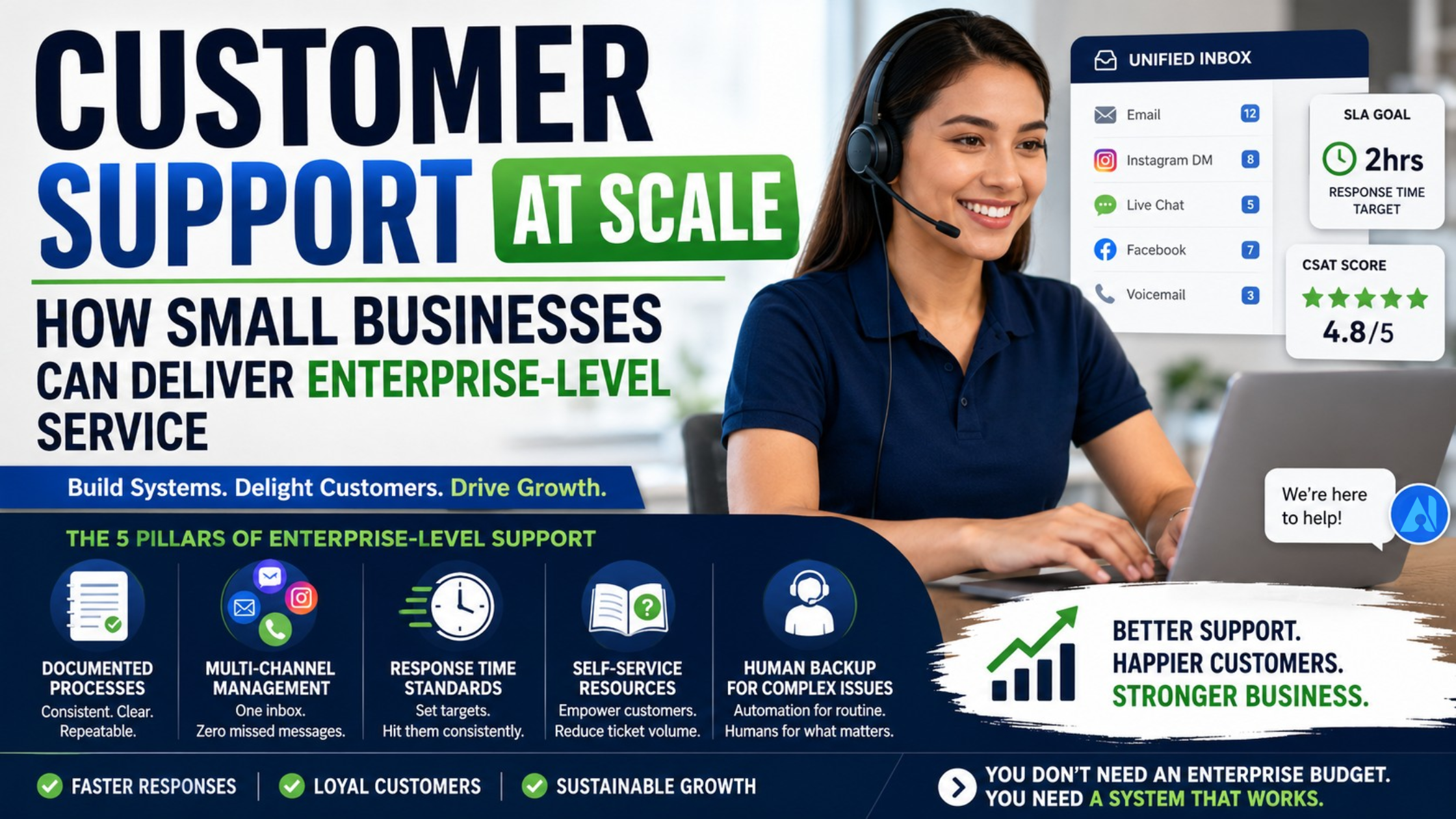
The 5 Pillars of Enterprise-Level Customer Support At Any Size
1. Documented Processes and Response Playbooks
Enterprise support teams don't wing it. Every common scenario, refund requests, shipping delays, product questions, and billing issues have a documented response protocol. The result is consistency. No matter who handles the ticket, the customer gets the same quality of service.
For small businesses, this starts with something as simple as a Google Doc or a shared Notion workspace. Audit your last 30 days of customer inquiries. What are the top 10 questions or issues that come up repeatedly? Write a clear, brand-voice-aligned response for each one. These become your playbooks.
This single step does two powerful things: it dramatically reduces response time, and it makes it possible for someone other than you to handle support without losing quality.
2. Multi-Channel Presence with Centralized Management
Your customers aren't all in the same place. Some send emails. Others DM you on Instagram. Some leave voicemails. A handful of posts directly on your Facebook page. Enterprise companies use help desk platforms like Zendesk, Freshdesk, or HubSpot Service Hub to pull all of these into a single queue so nothing falls through the cracks.
For small businesses, tools like Tidio, Zoho Desk, or even a well-configured Gmail with labels and filters can accomplish similar results at a fraction of the cost. The goal is simple: one dashboard, full visibility, zero missed messages.
Multi-channel presence without centralized management is a recipe for overwhelm. Multi-channel presence with a unified inbox is a competitive advantage.
3. Response Time Standards (And the Systems to Hit Them)
One of the clearest signals of a professional operation in the customer's eyes is how fast you respond. Not perfectly, but consistently. Enterprise companies set internal SLAs (Service Level Agreements) that define target response windows for each type of inquiry.
You can do the same. Set a response time standard that's realistic for your team size, whether that's two hours for urgent issues and 24 hours for general inquiries, and build your systems to hit it. Automated acknowledgment emails ("We received your message and will respond within X hours") buy goodwill while your team catches up. Even when you're small, this kind of structure signals that you run a professional operation.
4. Self-Service Resources That Reduce Ticket Volume
One of the most underused assets in small business customer support is a robust FAQ page or knowledge base. Enterprise companies invest heavily in self-service because it serves two purposes simultaneously: it empowers customers to find answers instantly, and it deflects repetitive inquiries away from your support team.
Think about this: if 30% of your support volume is the same five questions, answering those questions proactively on your website eliminates nearly a third of your incoming workload before it even becomes a ticket. An organized FAQ page, short tutorial videos, or even a simple chatbot that surfaces common answers can have an outsized impact on your team's capacity and your customer's satisfaction.
5. Human Backup for Complex Issues
Even the most automated systems in the world at companies like Amazon and Apple route escalations to real humans. The key insight here isn't that automation is a replacement for human judgment; it's that automation handles the routine so your people can focus on the complex.
For small businesses, this means making sure that there is always a clear escalation path: a point at which a real, knowledgeable person steps in to handle issues that require nuance, empathy, or authority. Customers forgive slow automation. They rarely forgive feeling brushed off when they have a real problem.
The Staffing Gap: Why Most Small Businesses Fall Behind on Support
Here's the uncomfortable truth most business owners already know: time is the bottleneck.
You didn't start your business to spend four hours a day answering emails. Your team, if you have one, was hired for revenue-generating or operational functions, not to field customer service tickets. And yet the tickets keep coming.
The traditional response to this is to hire a full-time or part-time customer service employee. But that comes with real costs: salary, benefits, onboarding, management overhead, and the simple risk that demand fluctuates while the salary doesn't.
This is exactly why the growth of virtual assistant (VA) services has been so significant for small and mid-size businesses. A skilled VA, particularly one trained in customer-facing communication and support workflows, can handle email management, live chat responses, social media DMs, appointment scheduling, CRM updates, and follow-up sequences at a fraction of the cost of a full-time hire.
More importantly, a VA scales with you. Need more coverage during a product launch or busy season? Scale up. Need to trim overhead during a slower period? Scale back. This kind of flexibility is something in-house teams simply can't offer.
Technology as a Force Multiplier
You don't have to spend enterprise money to access enterprise-grade tools. The SaaS market has democratized customer support technology in a way that genuinely levels the playing field.
Here are tools worth evaluating at different stages of growth:
For early-stage businesses (under 50 tickets/month): A well-organized Gmail inbox with filters, canned responses, and a clear labeling system can get you surprisingly far. Pair it with Calendly for scheduling and a simple FAQ page, and you have a serviceable support system.
For growing businesses (50–300 tickets/month): Tools like Freshdesk (free tier available), Tidio (chat + chatbot), and Notion or Confluence for internal documentation start to make a significant difference. Consider integrating a CRM like HubSpot Free to track customer history and context.
For scaling businesses (300+ tickets/month): At this volume, you want a full help desk platform (Zendesk, Intercom, or Freshdesk Pro), a dedicated VA or small support team working from shared playbooks, automated ticket routing, and performance reporting to identify bottlenecks.
The goal at every stage is the same: reduce manual effort, increase response consistency, and make it easy for anyone on your team to deliver the same quality of service you would deliver yourself.
Metrics That Actually Matter
One of the hallmarks of enterprise support is measurement. They track response times, resolution rates, customer satisfaction scores (CSAT), and Net Promoter Scores (NPS). They use data to identify what's working and where the system is breaking down.
You don't need a data analyst to do this. Start with three simple metrics:
Average First Response Time — How long does it take for a customer to receive their first reply? This is the single metric most correlated with customer satisfaction.
First Contact Resolution Rate — What percentage of issues are resolved in the first interaction, without a follow-up needed? A high rate here signals strong playbooks and capable support staff.
Customer Satisfaction Score (CSAT) — A simple one-question survey ("How satisfied were you with the support you received?") sent after ticket resolution gives you direct feedback on where your system is succeeding and where it's falling short.
Review these monthly. Trends matter more than single data points.
Putting It Together: A Practical Roadmap
If you're starting from scratch or trying to fix a broken support system, here's a realistic sequence:
Week 1–2: Audit your current support volume and categorize the top inquiry types. Build your first set of response templates and an FAQ page.
Week 3–4: Choose a help desk tool appropriate for your current volume and migrate your support channels into it.
Month 2: Hire or onboard a virtual assistant trained in customer support. Provide them with your playbooks and run a two-week parallel period where you review their responses before they go live.
Month 3 and beyond: Track your three core metrics. Identify the highest-volume or highest-friction ticket categories and systematically build better solutions, better self-service content, better automation, better training for each one.
Customers don't care about your headcount. They care about how fast you respond, how clearly you communicate, and whether you actually solve their problem. The businesses that earn loyalty — at any size — are the ones that take support seriously enough to build real systems around it.
The good news is that the tools, strategies, and talent to build those systems have never been more accessible. You don't need an enterprise budget. You need a plan, the right infrastructure, and the willingness to delegate effectively.
When customer support works the way it's supposed to, it stops being a drain on your time and starts being one of the most powerful drivers of retention and revenue in your business.
That's not an enterprise advantage anymore. That's yours.
Want to learn how a trained virtual assistant can transform your customer support operations? Explore AIVO Virtual Operations' services