
Domestic Violence Awareness Month: What Small Business Owners and Managers Can Do
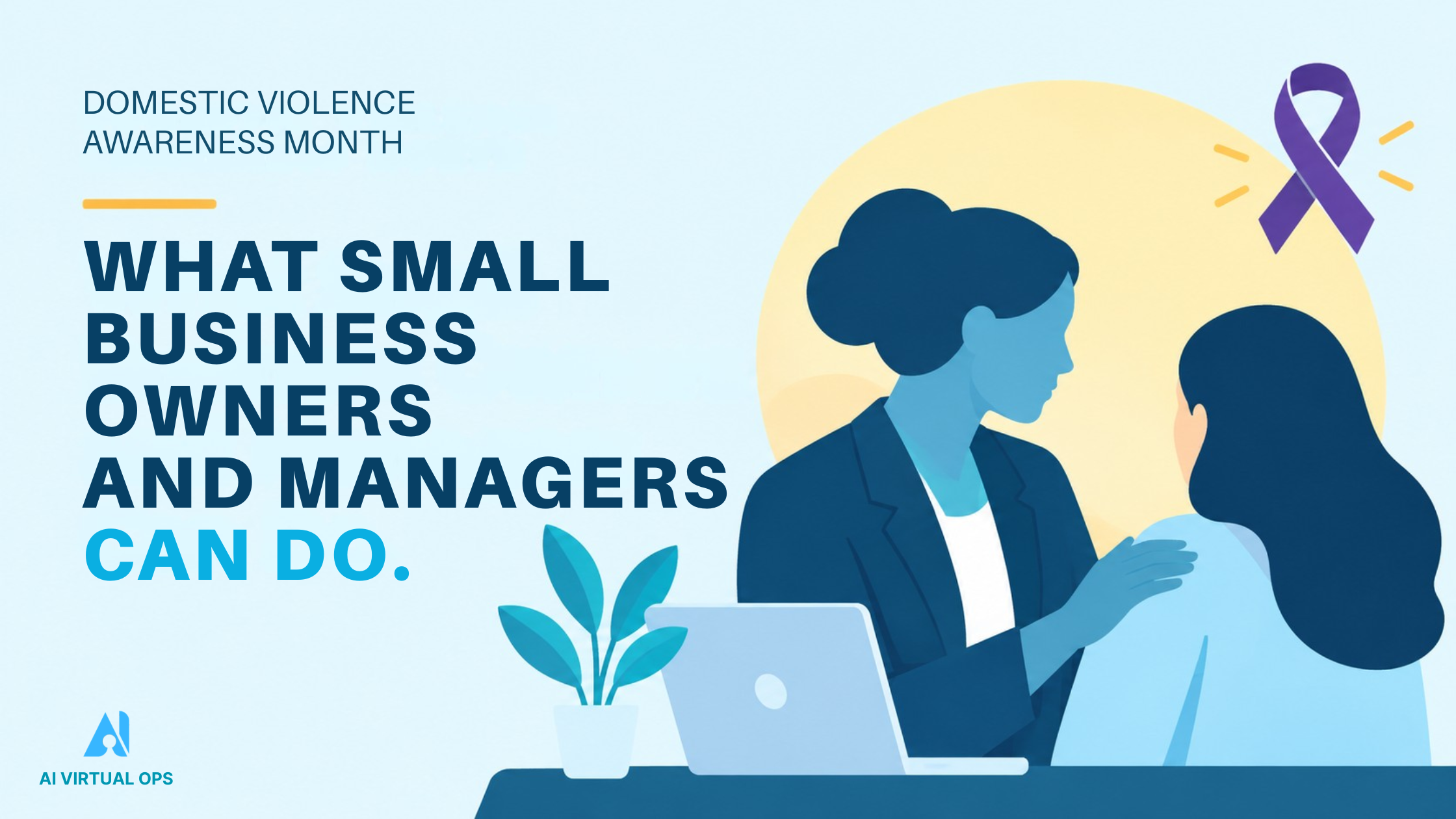
This is an awareness post, not a sales one. No services are being promoted here — just information that might matter to someone reading this.
October is Domestic Violence Awareness Month, a designation that's existed in the U.S. since 1989 and is observed in various forms around the world. For most businesses, that fact passes by as a calendar note. But if you run a small business or manage even a handful of people, you are, statistically, more connected to this issue than you might think.
According to the National Coalition Against Domestic Violence, roughly 1 in 4 women and 1 in 9 men in the United States experience severe intimate partner violence in their lifetime. That means in almost any team of meaningful size, someone — an employee, a coworker, a client, a vendor you talk to regularly — has lived through this or is living through it now.
Why This Is a Workplace Issue, Not Just a Personal One
Domestic violence doesn't stay contained to someone's home life. It shows up at work in ways that are easy to misread if you don't know what you're looking at:
-
Unexplained absences or chronic lateness
-
A sudden drop in concentration or performance
-
Visible anxiety around phone calls, texts, or a partner showing up unannounced
-
Reluctance to discuss home life, or inconsistent explanations for injuries
-
Using sick days or vacation time in a pattern that doesn't match typical use
None of these signs are proof of anything on their own. People have bad weeks for all kinds of reasons, and jumping to conclusions can do more harm than staying quiet. But small business owners and managers are often in a unique position: close enough to notice a change, but without the formal HR infrastructure that larger companies have to handle it well.
What You're Not Responsible For
It's worth saying clearly: you are not a counselor, an investigator, or a crisis responder, and you shouldn't try to be. You don't need to confront anyone, diagnose a situation, or insert yourself into someone's personal life. Trying to "solve" this yourself, without training, can sometimes make things more dangerous for the person involved, not less.
What You Can Actually Do
The role of a manager or business owner here is narrower than people assume, and more achievable:
-
Notice without assuming. If something feels off, a simple, private "I've noticed you seem stressed lately — is everything okay?" opens a door without forcing anyone through it.
-
Keep the conversation confidential. If someone does share something, who else knows matters. Loop in HR or trusted leadership only as needed, not as office knowledge.
-
Know where to point people. You don't have to have the answers. You just have to know the number: the National Domestic Violence Hotline is 1-800-799-7233, available 24/7, with confidential support and local resource referrals.
-
Be flexible where you can. Time off for court dates, counseling, or safety planning — handled quietly and without requiring an explanation — can matter more than any policy document.
-
Review your own policies. Does your business have any guidance at all for this situation? Many small businesses don't, simply because it's never come up — until it does.
Why Small Businesses Are Often the Last to Think About This
Large companies tend to have an HR department, an employee assistance program, and a written policy for exactly this kind of situation. Small businesses usually have none of that — not because owners don't care, but because it's rarely the thing anyone has time to build until it's already needed. That gap is worth closing before a crisis forces the issue, not after.
Building that readiness doesn't require a lawyer or a formal program. It can be as simple as:
-
Printing the hotline number and keeping it somewhere private — a staff bathroom, a break room bulletin board, a shared but discreet document — rather than only in a manager's head
-
Deciding in advance who an employee could go to if they needed to talk, so that person isn't figured out in the moment
-
Agreeing, even informally, that requests for schedule flexibility won't require an explanation
-
Making sure at least one person in leadership knows the basics of safety planning resources, even if they never end up using that knowledge
None of this is complicated. It's mostly a matter of deciding, ahead of time, that this is something your business is prepared to respond to with care rather than confusion.
What Not to Do
A few common instincts tend to backfire, worth naming directly:
-
Don't confront the other person involved, even if they also work at your business or are known to you. This can escalate real danger for the employee.
-
Don't share what you've noticed with coworkers, even with good intentions. Privacy is often central to someone's safety.
-
Don't make decisions on someone's behalf — offer resources and flexibility, but let them lead on what they want to do next.
-
Don't treat a disclosure as a performance issue. Someone going through this may already be managing an enormous amount; piling on professional consequences rarely helps and can make someone less likely to ask for support in the future.
A Month, Not a Moment
Awareness months tend to generate a wave of posts and then disappear from view for eleven months. The more useful version of this is quieter: knowing the signs, knowing the number, and being the kind of workplace where someone would feel safe saying something is wrong, in October and in every month after it.
Most small business owners will never have to use any of this. But for the ones who do, having thought about it even a little beforehand tends to make a real difference in how well they're able to show up for someone who needed it.
If you or someone you know needs support, the National Domestic Violence Hotline is available 24/7 at 1-800-799-7233, by text (start with "START" to 88788), or online at thehotline.org.