
Human Virtual Assistant vs. AI Tools: What Every Small Business Owner Needs to Know in 2026
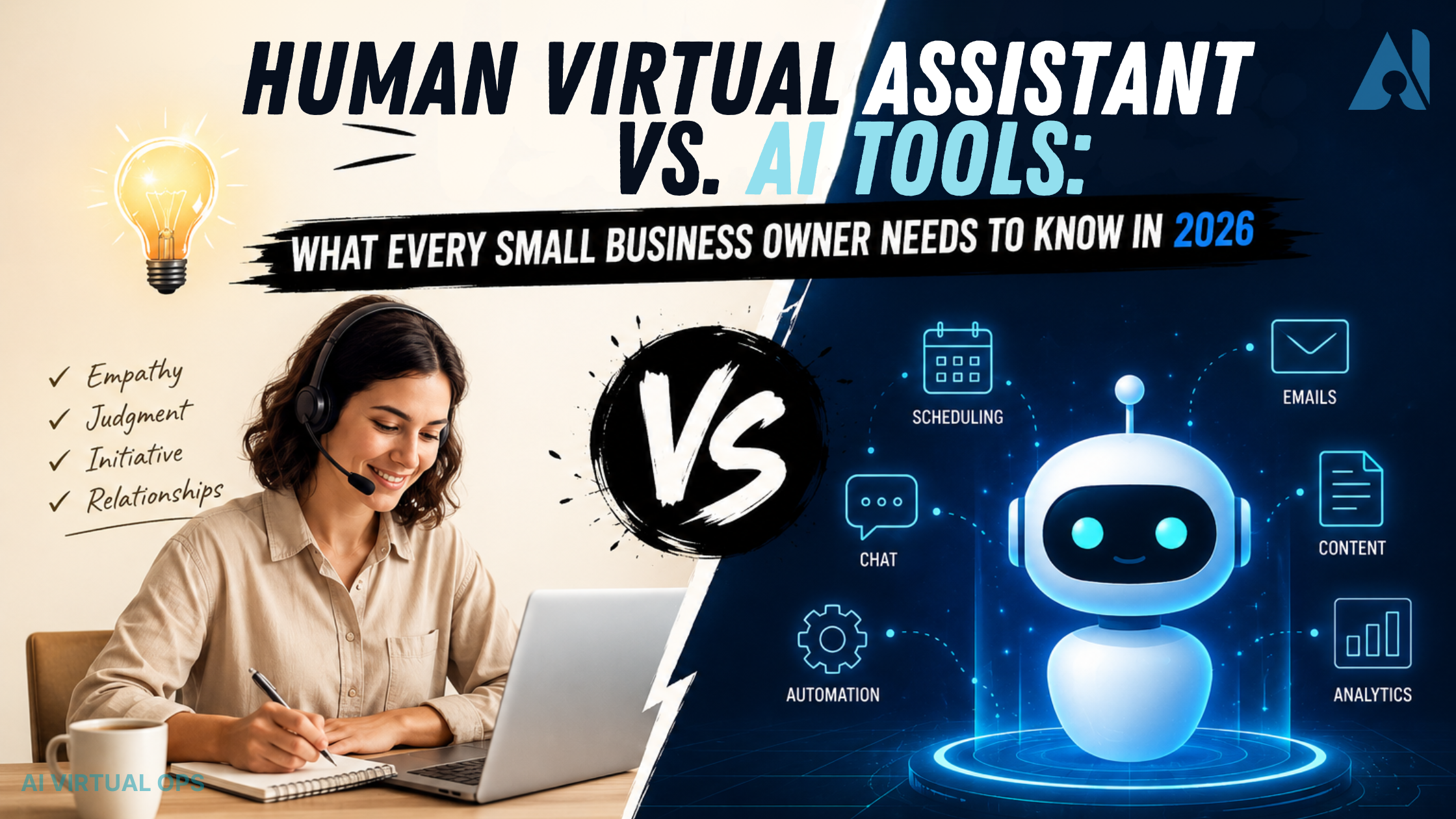
You're juggling customer emails, scheduling, invoices, social media, and about twelve other things before noon. At some point, probably during your third unanswered voicemail of the morning, you've asked yourself: Do I hire a virtual assistant, or do I just let AI handle it?
It's one of the most consequential decisions a small business owner can make in 2026. The answer isn't as clean as tech evangelists or staffing agencies would have you believe. Both options have evolved dramatically, and the gap between them is no longer as obvious as "human = better" or "AI = cheaper." The truth is more nuanced and a lot more useful once you understand it.
This guide breaks it all down so you can make the right call for your business, your budget, and your sanity.
What We're Actually Comparing
Before diving in, let's define terms. A Human Virtual Assistant (VA) is a remote professional, often freelance or agency-sourced, who handles tasks for your business on a part-time or full-time basis. They work asynchronously or in real-time, communicate in human language, and bring judgment and experience to the table.
AI Tools in 2026 span a wide spectrum: from AI-powered email sorters and scheduling apps to sophisticated large language model assistants capable of drafting proposals, managing customer FAQs, analyzing data, and generating content. Platforms like Claude, ChatGPT, Gemini, and specialized vertical tools have matured considerably in the past two years.
Both serve the same overarching goal: freeing you from repetitive or time-consuming work so you can focus on what moves the needle. But they do it very differently.
Where Human VAs Still Have the Edge
Complex Judgment & Nuanced Communication
When a longtime client sends a passive-aggressive email about a missed deadline, you don't want an algorithm drafting your reply. Human VAs read context, pick up on relationship history, and navigate tone in ways that AI still stumbles with. For client-facing roles that require emotional intelligence or brand voice consistency, a trained VA is worth every penny.
Cross-Platform & Cross-Task Agility
A skilled VA can jump from booking a flight to handling a vendor dispute to preparing a quarterly summary in the same morning without being retrained or re-prompted. They adapt dynamically. AI tools are increasingly capable of multi-step tasks, but they still require thoughtful prompting and oversight for complex, context-heavy workflows.
Accountability & Ownership
When something goes wrong, a human VA can own the problem and fix it independently. They'll notice when a client hasn't responded in two weeks and flag it. They'll catch the typo in the contract before it goes out. Proactive initiative without being told is still a distinct human advantage.
"The best virtual assistants don't just complete tasks — they anticipate problems you haven't noticed yet. That's the kind of leverage that changes how a business operates."
— Operations strategist, quoted at the 2025 SMB Digital Summit
Where AI Tools Genuinely Win
Speed & Scale at Zero Marginal Cost
Need 50 product descriptions written? An AI tool produces them in minutes. Need to summarize 200 customer reviews into themes? Done in seconds. AI doesn't clock out, doesn't have sick days, and doesn't charge overtime. For volume-based, repeatable tasks, content generation, data formatting, transcription, FAQ drafting, AI is simply faster and dramatically cheaper.
Always-On Availability
If your business operates across time zones or has customers who reach out at 2 a.m., AI is your only practical 24/7 option. Chatbots and AI customer service tools have improved to the point where they can handle first-contact resolution for a wide range of inquiries without any human intervention.
Consistent Execution of Defined Processes
For well-defined, documented tasks, think: categorizing expenses, formatting reports, sending follow-up sequences. AI is more consistent than any human. It doesn't forget steps. It doesn't have bad days. If you've systematized a process clearly, AI executes it the same way every time.
The Real Cost Breakdown in 2026
Factor | Human VA | AI Tools |
Monthly Cost (Part-Time) | $800 – $3,000+ | $20 – $300 (subscriptions) |
Onboarding Time | 1–3 weeks | Hours to days |
Emotional Intelligence | ★ Human Wins | Improving, not there yet |
Volume Output | Limited by hours | ★ AI Wins |
Proactive Initiative | ★ Human Wins | Task-reactive only |
Consistency | Variable | ★ AI Wins |
Data Privacy Risk | Contractual controls | Platform-dependent |
Creative Flexibility | ★ Human Wins | Strong but needs direction |
Setup & Maintenance | Relationship-based | Prompt engineering required |
The Mistake Most Small Business Owners Make
Here's the real trap: treating this as an either/or decision. Most small business owners either over-invest in a VA for tasks that AI could handle in minutes, or they over-rely on AI for client relationships and judgment calls that require a human touch and pay for it in strained relationships and costly errors.
The owners who are winning in 2026 have stopped asking "which is better?" and started asking "which task belongs to which tool?"
Tactical Framework
How to Assign Tasks in a Hybrid Setup
Route to AI: First-draft content, data entry, transcription, FAQ responses, email templates, scheduling links, expense categorization, and meeting summaries.
Route to Human VA: Client relationship management, complex scheduling with judgment, vendor negotiations, inbox triage with context, executive support, and anything requiring brand voice curation.
Human reviews AI output: Proposals, contracts, customer-facing social content, sensitive communications.
Building Your Hybrid Stack: A Practical Approach
The most efficient small businesses in 2026 operate with what's being called a "1+AI" model, one skilled human VA supported by a curated suite of AI tools. The VA focuses exclusively on high-judgment, relationship-sensitive work while AI handles volume and consistency.
Step 1: Audit Your Task List
Track everything you or your team does for two weeks. Categorize each task by whether it requires judgment, emotion, or context, or whether it's rule-based and repeatable.
Step 2: Automate the Repeatable
Identify your highest-volume, lowest-judgment tasks. These go to AI first. Start with one or two tools, master them, then expand.
Step 3: Hire for What Remains
Once AI handles the volume, you'll have a much clearer picture of what a VA actually needs to do, making it easier to hire the right person at the right scope.
Step 4: Build a Handoff Protocol
Document which tasks flow through AI, which go to your VA, and which require your direct attention. Review and update quarterly as both your business and the tools evolve.
What to Watch For in the Second Half of 2026
The landscape is moving fast. AI agents, tools that can take multi-step autonomous action across apps and platforms, are becoming more reliable and accessible for small businesses. We're entering a period where an AI "agent" can draft, send, follow up on, and log a client proposal with minimal human input. This will compress the advantage human VAs have in task execution, but it will also increase the premium on human VAs who can manage these AI systems and handle the exceptions they create.
The smartest investment you can make right now is in a VA who is already fluent in AI tools. They become a force multiplier, not a replacement for technology, but the human judgment layer on top of it.
The Bottom Line
In 2026, the question isn't "human VA or AI?" It's "how do I combine both to build a business that runs without burning me out?" Human VAs bring irreplaceable judgment, initiative, and relationship intelligence. AI tools bring speed, scale, and consistency. Together, they're not just complementary, they're compounding.
Start by automating what you can. Hire human talent for what matters most. Build a system, not a dependency. Your future self, the one actually taking a weekend off, will thank you.