
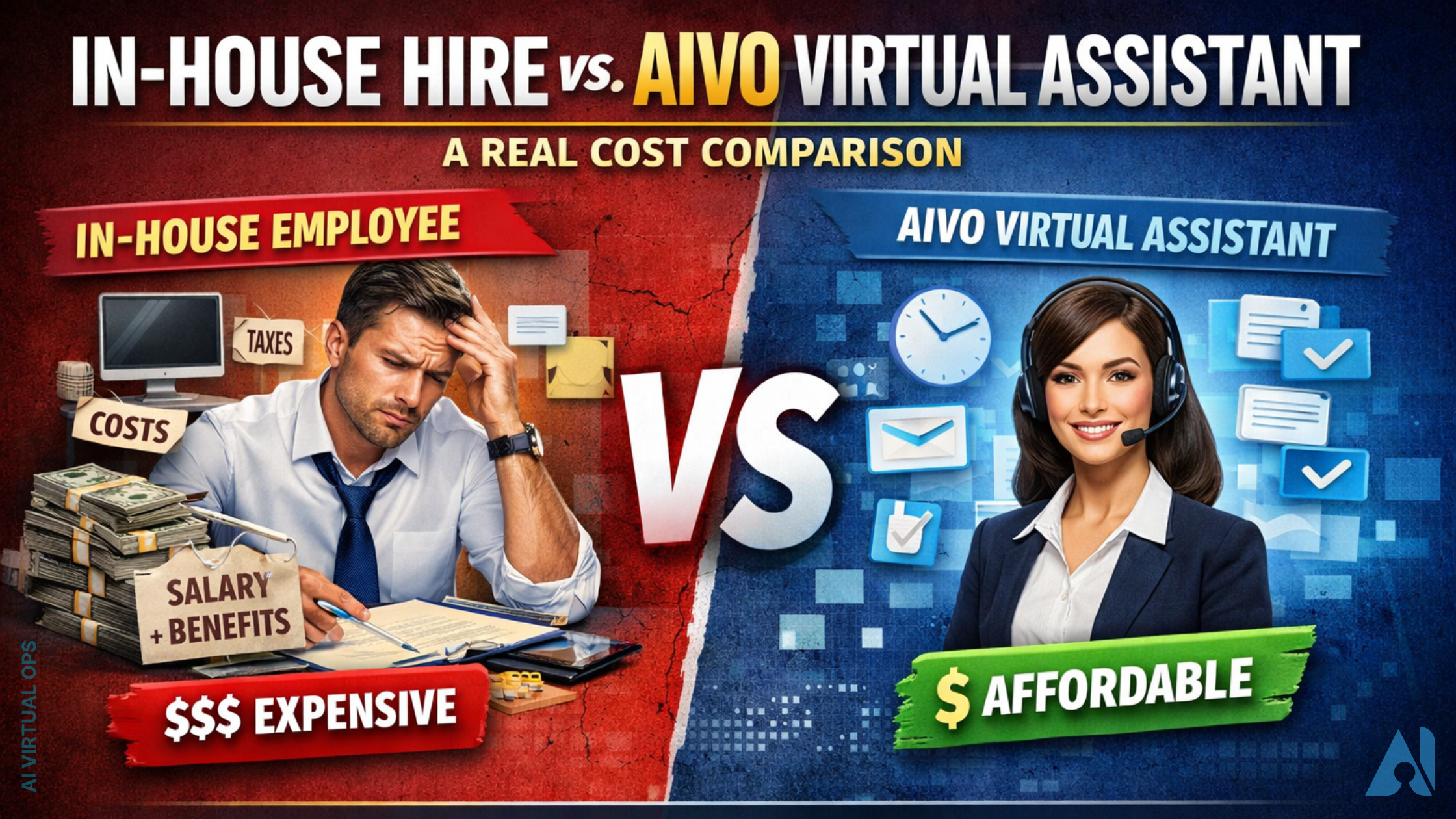
In-House Hire vs. AIVO Virtual Assistant: A Real Cost Comparison Every Business Owner Needs to See
The Hiring Dilemma Every Business Owner Faces
You need more hands on deck. Tasks are piling up: emails, scheduling, customer inquiries, data entry, social media management, and you're stretched thin. The logical next step seems obvious: hire someone.
But how you hire could be the most important financial decision you make this year.
For business owners today, there are two primary paths: bring on a full-time, in-house employee, or partner with a Virtual Assistant service like AIVO. At face value, an in-house hire feels safer, more controllable, more "professional." But once you break down the true cost of each option, the numbers tell a very different story.
This guide is designed to give you a clear, honest, and comprehensive cost comparison so you can make the decision that's best for your business, your budget, and your growth.
The Real Cost of an In-House Hire
Most business owners look at a job candidate's salary and think, "That's what this person will cost me." That is one of the most expensive misconceptions in business.
According to the U.S. Small Business Administration, the true cost of an employee is typically 1.25 to 1.4 times their base salary, and in many cases, considerably more.
Let's walk through every layer of cost.
1. Base Salary
The starting point. For a general administrative assistant in the United States, the average annual salary ranges from $38,000 to $55,000, depending on location and experience. In major metro areas like New York or San Francisco, expect that number to climb well above $60,000.
2. Payroll Taxes and Employer Contributions
As an employer, you're legally required to pay:
Social Security Tax: 6.2% of wages
Medicare Tax: 1.45% of wages
Federal Unemployment Tax (FUTA): up to 6% on the first $7,000 earned
State Unemployment Tax (SUTA): varies by state, typically 2%–5%
On a $45,000 salary, employer-side payroll taxes alone can add $5,000–$7,000 per year.
3. Employee Benefits
This is where costs escalate sharply. A competitive benefits package the kind required to attract and retain quality talent typically includes:
Health insurance: $6,000–$12,000/year per employee (employer contribution)
Dental and vision coverage: $500–$1,500/year
Paid time off (PTO): 10–15 days per year = roughly 4–6% of their salary paid for no active work
Sick leave: additional 5–7 days on average
Retirement contributions (401k match): 3%–6% of salary
Life and disability insurance: $500–$1,000/year
Totaling these conservatively, benefits can add $10,000–$20,000 per year on top of salary.
4. Recruitment and Onboarding Costs
Before you even have your new hire at a desk, you've spent money:
Job board listings and recruitment ads: $500–$2,000
Time spent interviewing (your time = your money)
Background checks and assessments: $100–$500
Onboarding and training: $1,500–$3,500 on average, per SHRM research
Lost productivity during ramp-up period: a new employee typically reaches full productivity after 3–6 months
5. Overhead and Workspace Costs
An in-house employee needs a place to work:
Office space: $500–$2,000/month per employee (if you're in a leased office)
Computer and hardware: $1,000–$2,500 (upfront)
Software licenses: $50–$300/month
Desk, chair, supplies, internet share: $500–$1,500 (setup)
Utilities (proportional share): $100–$300/month
For a business with physical office space, workspace overhead can easily add $10,000–$25,000 per year.
6. Turnover Risk
The average employee tenure in administrative roles is approximately 2–3 years. When an employee leaves, you start the entire process again, recruiting, onboarding, training, and absorbing lost productivity.
SHRM estimates the cost of replacing an employee at 50%–200% of their annual salary, depending on the role.
Total Estimated Annual Cost of an In-House Hire
Cost Category | Estimated Annual Cost |
Base Salary | $40,000 – $55,000 |
Payroll Taxes | $5,000 – $7,000 |
Benefits Package | $10,000 – $20,000 |
Recruitment & Onboarding | $2,500 – $6,000 (amortized) |
Office & Equipment | $10,000 – $25,000 |
Total Estimated Cost | $67,500 – $113,000+/year |
That means a single in-house administrative employee can cost your business anywhere from $67,500 to over $113,000 per year, far beyond the salary line on a job posting.
The Cost of an AIVO Virtual Assistant
Now let's look at AIVO, a professional Virtual Assistant service built to deliver skilled, dedicated support at a fraction of traditional hiring costs.
What Is AIVO?
AIVO provides businesses with trained, professional Virtual Assistants who work remotely to handle a wide range of tasks: administrative support, email management, calendar coordination, customer service, research, social media, bookkeeping support, and more. Think of AIVO as giving you the output of a skilled employee without the overhead of being an employer.
How AIVO Pricing Works
AIVO typically offers flexible service packages based on hours or scope of work, allowing business owners to pay only for what they actually need. Whether you need 10 hours a week or full-time coverage, AIVO scales to your requirements.
Typical pricing structures for Virtual Assistant services like AIVO range from:
Part-time support (20 hrs/week): ~$800–$1,500/month
Full-time equivalent support (40 hrs/week): ~$1,500–$3,000/month
On an annualized basis, that translates to approximately $9,600–$36,000 per year — compared to $67,500–$113,000 for an in-house hire.
What You Don't Pay With AIVO
This is the critical difference. With an AIVO Virtual Assistant, you are not responsible for:
✅ Payroll taxes
✅ Health insurance or benefits
✅ Paid time off or sick leave
✅ Office space or equipment
✅ Recruitment or onboarding fees
✅ Severance or turnover replacement costs
✅ HR compliance and labor law management
All of that cost, risk, and administrative complexity is eliminated.
Total Estimated Annual Cost of an AIVO Virtual Assistant
Cost Category | Estimated Annual Cost |
Service Fee (full-time equivalent) | $18,000 – $36,000 |
Taxes & Benefits | $0 |
Recruitment & Onboarding | $0 |
Office & Equipment | $0 |
Total Estimated Cost | $18,000 – $36,000/year |
Side-by-Side Comparison
Factor | In-House Hire | AIVO Virtual Assistant |
Annual Cost | $67,500 – $113,000+ | $18,000 – $36,000 |
Payroll Taxes | Yes | No |
Benefits | Yes ($10K–$20K/yr) | No |
Office Space Required | Yes | No |
Equipment Costs | Yes | No |
Recruitment Cost | Yes | No |
Turnover Risk | High | Minimal |
Scalability | Slow & expensive | Immediate & flexible |
HR Compliance | Your responsibility | Managed externally |
Onboarding Time | 3–6 months | Days to weeks |
Beyond the Numbers: Strategic Advantages of AIVO
The financial case is compelling on its own, but the business advantages of choosing AIVO go beyond the bottom line.
Flexibility and Scalability. Business needs change. With an in-house employee, scaling up means another round of hiring; scaling down means layoffs, legal exposure, and morale damage. With AIVO, you can adjust your support level as your business evolves seamlessly, without friction.
Access to Specialized Skills AIVO Virtual Assistants are trained professionals who bring specialized expertise to the table. Rather than hiring a generalist and spending months training them, you gain access to people who are already proficient in the tools, workflows, and tasks your business needs.
No Management Overhead Managing an employee takes time, performance reviews, HR issues, sick days, and scheduling conflicts. AIVO handles its own workforce management, so you focus on growing your business, not administering a team.
Risk Reduction Hiring employees comes with legal exposure to wrongful termination claims, labor disputes, and compliance failures. The virtual assistant model significantly reduces that risk profile for small and medium-sized business owners.
When an In-House Hire Still Makes Sense
Fairness demands we acknowledge this: there are situations where an in-house hire is the right call.
Roles that require consistent physical presence (warehouse, retail, hands-on operations)
Positions demanding access to highly sensitive proprietary systems with strict on-site security requirements
Leadership roles where in-person culture building is a strategic priority
Highly specialized technical roles where deep institutional knowledge is critical
For these situations, the in-house investment may be justified. But for the wide range of administrative, operational, and support functions that keep most businesses running day-to-day? The math overwhelmingly favors AIVO.
As a business owner, every dollar you spend should return value. When you compare the true, fully-loaded cost of an in-house hire against the streamlined, transparent pricing of an AIVO Virtual Assistant, the choice becomes clear.
You can spend $67,500 to over $113,000 per year on a single in-house employee covering salary, taxes, benefits, space, equipment, and the hidden costs most owners never see coming.
Or you can invest $18,000 to $36,000 per year with AIVO, get professional, skilled support, and keep the remainder working for your growth.
That's not just a cost saving. That's a strategic advantage.
If you're a business owner looking to do more with less without sacrificing quality or reliability, AIVO Virtual Assistant isn't just a smart option. It's the smartest one on the table.
Ready to see what an AIVO Virtual Assistant can do for your business? Contact AIVO today and discover a smarter way to grow.
Disclaimer: Cost figures cited in this article are estimates based on publicly available industry data and averages as of 2024–2025. Actual costs will vary based on location, industry, role specifics, and individual business circumstances.