
L1-L2 Tech Support VAs: The Missing Layer Between Your Customers and Your Dev Team
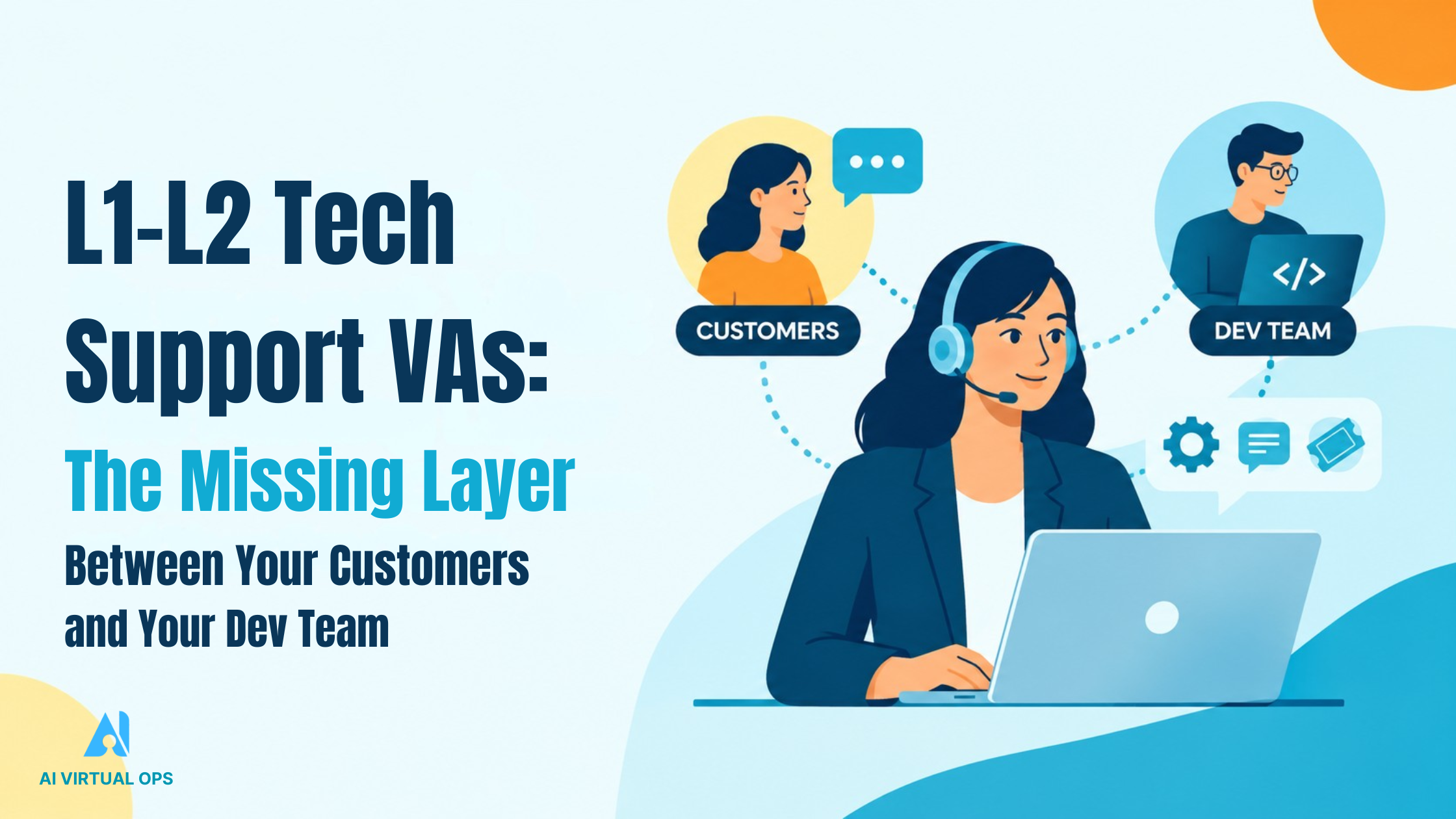
If you run a product-based or tech-enabled small business, you already know the pattern: a support ticket comes in, and either it sits unanswered for hours, or it lands directly on a developer's desk — someone whose time is far better spent building than resetting a customer's password for the third time this week.
Most small businesses don't have the ticket volume to justify a full internal support team, but they have more than enough volume to make "whoever's free handles it" a genuinely bad system. That gap is exactly where an L1-L2 Tech Support VA fits.
What L1 and L2 Actually Mean
Support tickets generally fall into tiers:
-
L1 (Tier 1): Common, well-documented issues — password resets, account access, basic how-to questions, known bugs with existing workarounds
-
L2 (Tier 2): More involved troubleshooting that requires digging into logs, reproducing an issue, or coordinating between systems, but still doesn't require a developer to write new code
The vast majority of support tickets at a small or mid-sized company fall into these two tiers. An L1-L2 Support VA handles both, which means your actual engineering team only sees the tickets that genuinely need their attention.
Why This Matters More Than It Looks Like It Does
Every minute a developer spends on a password reset is a minute not spent on the roadmap. Every hour a ticket sits unanswered is an hour a customer spends deciding whether your product is worth the trouble. Neither of those costs shows up on a spreadsheet, but both of them compound.
An L1-L2 Support VA closes that gap on both sides: customers get faster responses, and your technical team gets their time back for the work that actually requires their skill set.
What an L1-L2 Support VA Handles Day to Day
-
Ticket triage — sorting incoming requests by urgency and complexity
-
First-response resolution — closing out common issues using documented processes and known fixes
-
Troubleshooting — reproducing issues, checking logs, and narrowing down root causes before anything is escalated
-
Escalation management — writing clear, technical handoffs so developers aren't starting from scratch when a ticket does reach them
-
Documentation upkeep — updating help articles and internal runbooks as new issues and fixes come up
The Case for Getting This Right Early
Support quality tends to get worse exactly when a business can least afford it — during a growth spike, a product launch, or a seasonal surge — because that's when ticket volume jumps fastest and internal teams are already stretched thin. Businesses that build a tiered support structure before they need it avoid the scramble entirely. The ones that wait usually end up fixing the system under pressure, after customers have already noticed the slowdown.
Faster Answers, Fewer Interruptions
An L1-L2 Support VA isn't about doing support "on the cheap." It's about putting the right level of expertise on the right problem — so your customers get fast, competent answers, and your technical team only gets pulled in when it actually matters.
AI Virtual Ops places human L1-L2 Tech Support VAs with small businesses that need a real triage layer, not an overloaded inbox. Book a free consult to see what support structure fits your ticket volume.