
Social Media Management vs. Community Management: Why Tools Alone Fail Your Brand
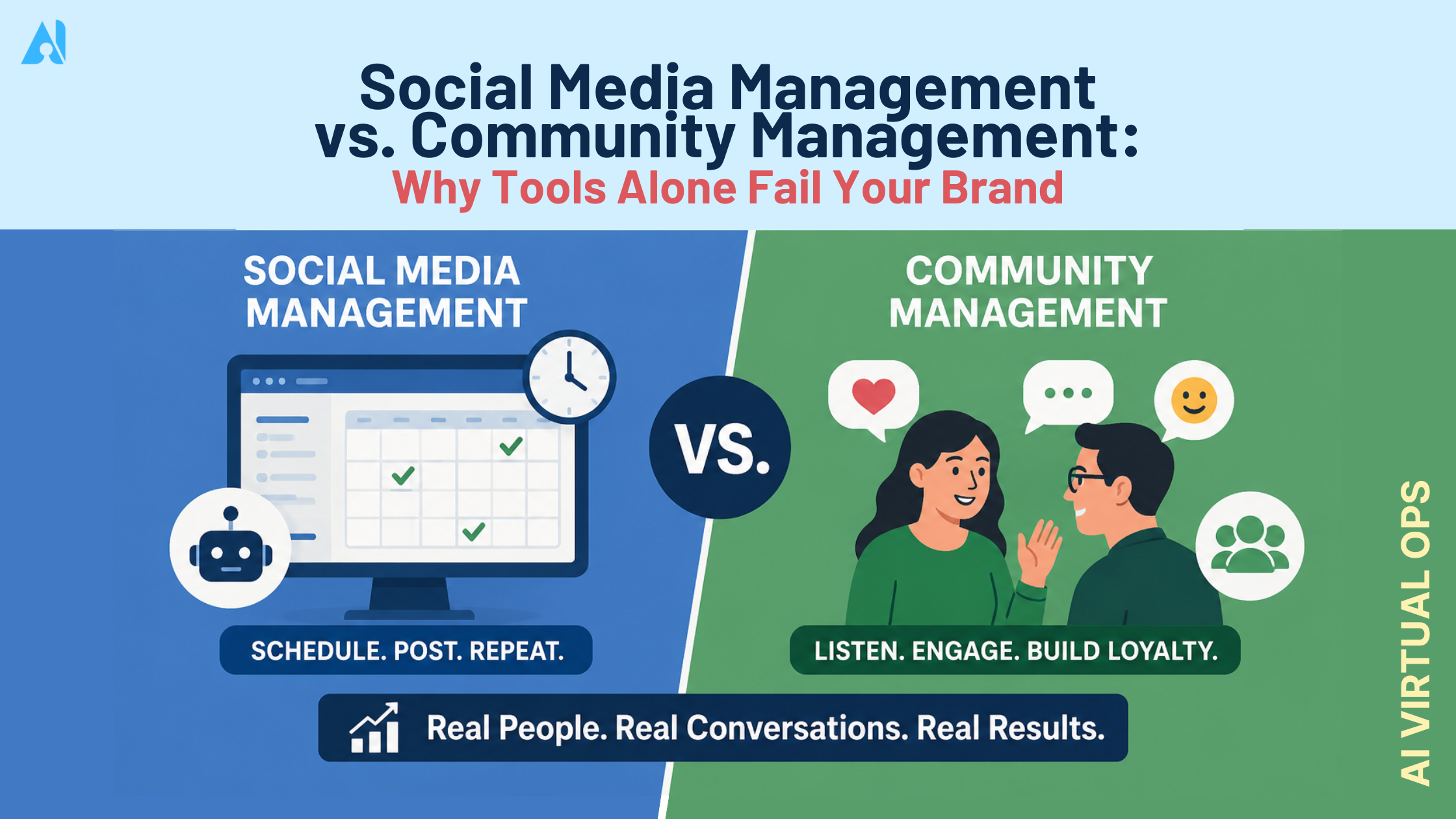
For modern business owners, scaling an online presence often feels like a race against content consumption. The common playbook says: produce content, queue it up in an automation tool, and watch your business grow. Platforms like HubSpot, Hootsuite, and Buffer have commoditized the scheduling process, making it easy to broadcast your messages to thousands of potential customers simultaneously. Yet, many business owners experience a frustrating paradox: despite maintaining a strict, automated publishing calendar, their engagement rates stagnate, conversion numbers drop, and their social pages resemble a ghost town.
The root cause of this dilemma lies in a foundational misunderstanding of the digital marketing landscape. Many founders use the terms Social Media Management and Community management interchangeably. However, they represent two entirely distinct operational tracks. While the former focuses on the structured broadcast of content, the latter focuses on the human interactions that follow. If you are relying solely on software to handle your social footprint, you are skipping the critical human layer required to transform a passive audience into a loyal client base.
Defining the Core Pillars: Management vs. Community
To fix a broken social media strategy, you must first separate the operational definitions of these two roles. They require different skill sets, different metrics, and completely different execution methodologies.
1. Social Media Management: The Blueprint and Content Pipeline
Social Media Management is logistical, strategic, and macro-focused. It centers on brand representation, planning, and publishing. A social media manager acts as the architect of your digital channels. Their responsibilities include:
-
Developing content calendars aligned with product launches, corporate milestones, or seasonal campaigns.
-
Overseeing asset creation, including promotional graphics, blog thumbnails, text formatting, and video formatting.
-
Analyzing big-data trends, such as click-through rates (CTR), impressions, follower growth, and optimal posting times.
-
Optimizing profiles for search engines and platform discovery algorithms.
This pipeline is highly technical and numbers-driven, and it can be organized using modern scheduling tools. However, it is fundamentally a one-way communication channel: your brand talking at your market.
2. Community Management: The Pulse and Human Interaction
Community Management is relational, reactive, and micro-focused. It begins the exact second after a post goes live. A community manager does not look at your audience as an aggregate data point; they view them as individual humans. Their responsibilities include:
-
Monitoring comment threads, direct messages (DMs), and mentions in real-time to answer product queries or troubleshoot service complaints.
-
Initiating and sustaining conversations, asking open-ended questions, and inserting an authentic human voice into corporate channels.
-
Tracking brand sentiment and gathering qualitative product feedback from daily customer touchpoints.
-
Mitigating public relations crises by handling negative comments professionally before they escalate.
76% The Engagement Mandate: According to consumer behavior studies by Sprout Social, 76% of consumers expect a response from a brand on social media within the first 24 hours of reaching out, and nearly half expect it within 4 hours. Automated bots and unmonitored queues cannot meet this demand safely or authentically.
The Structural Comparison
To help you structure your digital operations effectively, let us map out how these roles differ across key business performance indicators:
-
Primary Objective: Brand visibility, content distribution, and audience acquisition. - Audience retention, brand loyalty,
-
Communication Style: One-to-Many. Structured brand voice focused on announcements and Education. - One-to-One. Conversational, empathetic, and highly contextual.
-
Key Performance Indicators (KPIs): Impressions, reach, subscriber counts, and click-through rates. - Response speed, comment depth, customer satisfaction (CSAT), and brand sentiment.
-
Tool Dependency: High reliance on scheduling software, design suites, and analytics dashboards. - High reliance on human empathy, product knowledge, and communication agility.
The Limits of Automation: Why Software Alone Drops the Ball
Automation platforms are excellent for operational logistics. They ensure your blog links are posted on time and save your internal team hours of manual uploads. However, when software steps outside its logistics lane and tries to handle human interaction, brand damage often follows.
Consider the limits of automated auto-responders or AI-driven comment bots. When a customer leaves a nuanced, frustrated comment about a shipping delay, an AI bot might pick up on keywords and reply with a generic, cheerful message: "Thanks for reaching out! We love our community! Check our website for more updates!" This complete lack of contextual empathy alienates customers, making your brand look detached and uncaring.
Furthermore, social media platform algorithms heavily penalize passive broadcasting. Algorithms on platforms like LinkedIn, Facebook, and Instagram are designed to maximize meaningful human interactions. If your account drops content into the feed but never interacts with incoming responses, the algorithm flags your profile as a low-value broadcast account. This causes your organic reach to steadily drop, limiting the value of your content investments.
Real-World Scenarios: Content Launch vs. Real-Time Engagement
Let us look at how these dynamics play out in real-world business scenarios to understand why human engagement is so critical.
Scenario A: The Product Launch
Imagine a software company launching a new CRM integration. The Social Media Manager designs an excellent multi-channel campaign: high-quality graphics, clear copy, and scheduled releases timed across global time zones. The content drops flawlessly at 9:00 AM.
By 9:15 AM, a prospective client comments: "Does this integrate directly with Slack, or do we need to use a webhook?" A scheduling tool cannot answer this question. If that comment sits unanswered for 48 hours, the buyer moves on to a competitor. However, a dedicated community manager jumps on the comment within minutes, providing an accurate answer and sharing a direct link to a setup guide. That quick, human response transforms a simple comment into an active sales opportunity.
Scenario B: Crisis and Sentiment Control
A B2C service provider experiences an unexpected digital service outage. Frustrated customers flock to their latest promotional post to vent their issues. A scheduling tool will blindly continue posting scheduled promotional content, making the brand appear completely tone-deaf and unaware of its own operations.
A human community manager pauses the automated queue immediately. They step into the comment section to personally address every complaint, validate frustrations, and provide regular updates from the engineering team. By taking accountability in real time, they protect the company's reputation and de-escalate potential public relations issues before they spin out of control.
How Human Virtual Assistants Bridge the Gap
For small to medium business owners, hiring two distinct internal departments to handle social media can strain budgets. This is where modern human-centered operational models offer a powerful alternative. By leveraging a structured human virtual assistant, business owners can blend strategic scheduling with flexible, responsive human community management.
Human virtual assistants can step into your daily workflows to keep your community engaged and growing:
-
Active Inbox Monitoring: They manage your direct messages, filtering out spam while escalating qualified sales leads directly to your internal sales representatives.
-
Contextual Comment Responses: They reply to complex customer questions with customized text, using deep product knowledge rather than cold, robotic templates.
-
Proactive Outreach: They interact with industry leaders, partners, and related brand ecosystems to naturally build your brand's visibility and presence across networks.
-
Qualitative Analytics Reporting: While tools measure quantitative data like clicks, human assistants provide qualitative insights. They track what your community is actually saying, uncovering recurring pain points, product requests, and valuable customer feedback.
Conclusion: Strategic Next Steps for Business Owners
Automation is built to handle workflows, but only humans can truly build communities. As you plan your digital strategy, audit your current social channels. Are you treating your pages like simple digital billboards, or are you treating them like interactive corporate assets? Scheduling software will help you share your message, but it takes human empathy and real-time engagement to turn casual followers into paying customers.
To scale your digital operations without losing your authentic human touch, consider working with a professional service provider like AI Virtual Ops. Integrating skilled human virtual assistants into your workflow allows you to build a dynamic, responsive digital community that drives real, long-term business growth.