
Virtual Assistant Trends H2 2026: Niche Specialization, AI-Augmented VAs & What Business Owners Need to Know
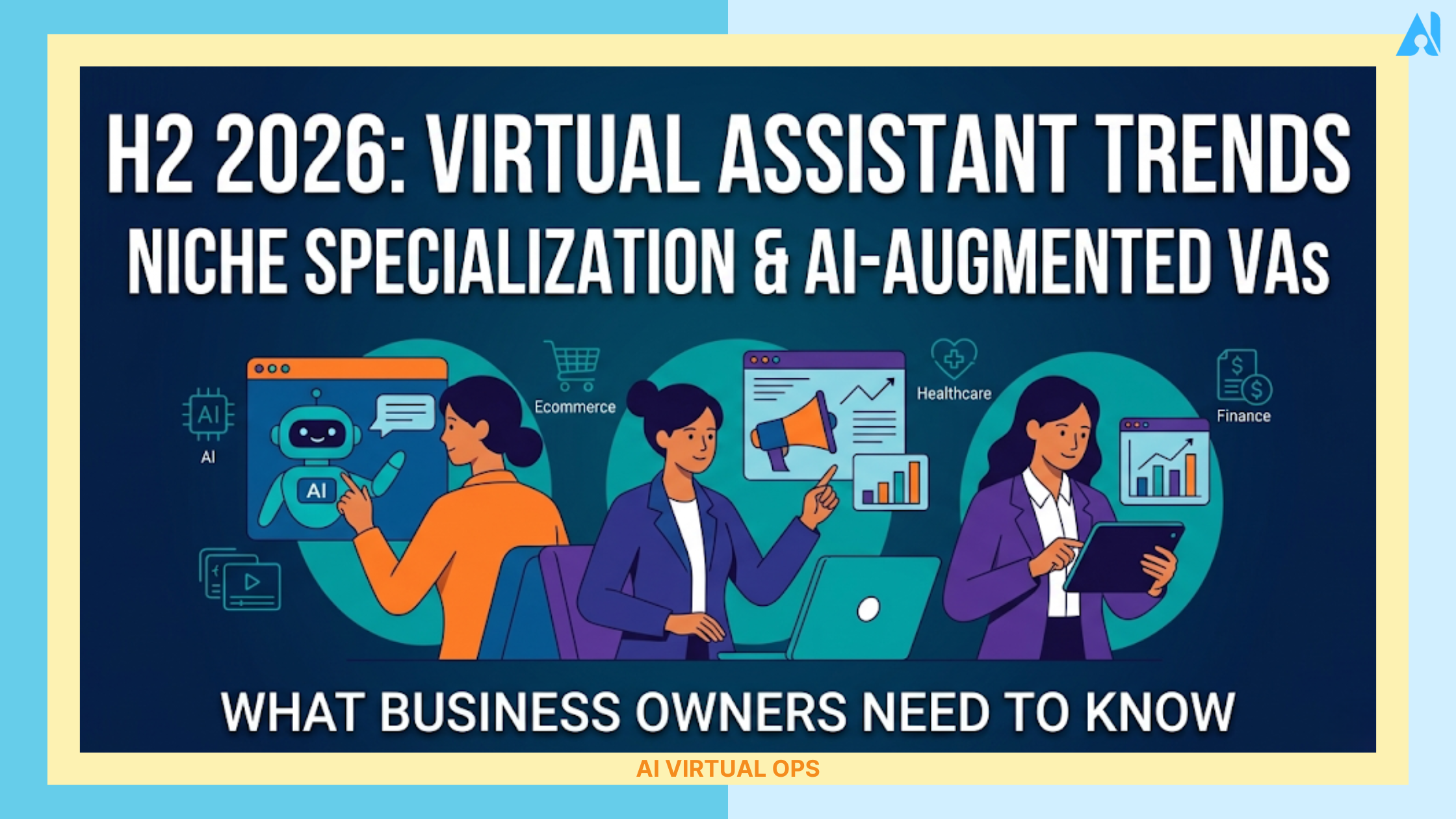
The VA Market Has Changed — Have You?
If you hired a virtual assistant two or three years ago and assumed the market hasn't changed much since, you're operating with an outdated map. The second half of 2026 marks a critical inflection point for business owners who outsource operational and administrative work and the changes underway are not incremental. They are structural.
The headline number tells part of the story: the global virtual assistant services market is projected to reach $6.5 billion in 2026, up from $5.3 billion just one year prior. More compellingly, long-range forecasts place the industry at $43.4 billion by 2035, representing a compound annual growth rate of 23.4% one of the fastest in the entire remote services sector (Wishup, 2026). These are not the numbers of a niche outsourcing trend. They represent a mainstream shift in how businesses are built and operated.
But market size alone doesn't tell you how to hire. For that, you need to understand the most important underlying trend reshaping the VA landscape: the rise of the niche specialist.
From Generalist to Specialist: The Defining Shift of H2 2026
For years, the default virtual assistant hire was a generalist someone who could handle your inbox, manage your calendar, book travel, and respond to customer emails. That model served a purpose. It was affordable, flexible, and low-friction. And it is increasingly obsolete.
According to Wishup's 2026 research, niche-specialized VAs focused exclusively on bookkeeping, eCommerce operations, legal support, or lead generation are replacing generalist assistants as the preferred hiring model for founders. The generalist hasn't disappeared entirely, but their role has narrowed: they handle commodity tasks that AI tools now partially automate, while the higher-value work flows to specialists.
The numbers support this shift convincingly. By the end of 2026, 40% of VAs are expected to offer highly specialized services in fields like IT, legal, and medical support (There is Talent, 2026). That's nearly half the market repositioning around expertise rather than availability. And for business owners, the practical implication is significant: if you're still hiring the way you did in 2022, you're likely leaving performance and ROI on the table.
Why is this shift happening now? Three forces are converging simultaneously.
First, AI has automated the floor. Basic administrative tasks scheduling, inbox sorting, data entry, simple research are now partially handled by AI tools. Any VA whose value proposition relied on those tasks alone is competing directly with software that costs a fraction of a human hire. The VAs who thrive are those whose skills complement AI rather than compete with it.
Second, clients have become more sophisticated. Business owners who have used VAs for several years have developed sharper expectations. They're no longer impressed by someone who can manage a calendar. They want someone who knows HubSpot inside and out, who can run an Amazon PPC campaign for a specific product category, or who understands medical billing workflows for a specific practice type.
Third, the specialization premium is real and growing. Specialized VAs see up to a 40% increase in client engagement after narrowing their focus (Wing Assistant, 2026). And while specialized VAs command higher rates, they consistently deliver measurably better outcomes making them the more cost-effective choice over time. By 2028, the specialization premium is projected to grow from 40–60% above generalist rates to 60–80% (VA Masters, 2026).
The Six Niche Specializations Gaining the Most Traction in H2 2026
So where is demand concentrating? Based on current hiring patterns and forward-looking projections, these are the niche categories business owners should understand heading into the second half of 2026.
1. AI-Augmented Operations VAs
The single biggest trend Wishup identifies for 2026 is the AI-augmented virtual assistant a human VA who uses tools like ChatGPT, Claude, Zapier, and other AI automation platforms to deliver roughly three times the output at the same cost as a traditional hire. This isn't a future projection; it's the new baseline. Over 40% of VAs now use AI-powered tools to automate tasks like data entry, scheduling, inbox triage, and customer support (There is Talent, 2026). By H2 2026, hiring a VA who doesn't use AI tools is the equivalent of hiring someone who doesn't use email.
For business owners, the practical ask is simple: during your next VA interview, ask them which AI tools they use daily and how those tools change their output. If they can't answer specifically, keep looking.
2. Bookkeeping and Financial Operations VAs
Finance-focused VAs represent one of the highest-value niches in the current market. A bookkeeping VA using QuickBooks AI or Xero automation doesn't just enter numbers they produce analysis, flag anomalies, prepare reports, and support month-end close processes that would otherwise require a part-time accountant. For small businesses and startups operating lean finance functions, this niche delivers an outsized return.
This is precisely the type of role where AI integration amplifies specialization. A bookkeeping VA using QuickBooks AI delivers results that a generalist VA simply cannot replicate manually, regardless of effort.
3. eCommerce Operations VAs
DTC brands, Amazon sellers, and Shopify merchants are driving enormous demand for VAs with platform-specific expertise. The trend toward hyper-specific hiring is most visible here: roles like "Amazon PPC specialist for supplement brands" and "Shopify operations manager for DTC fashion brands" are actively being posted and filled (VA Masters, 2026). These aren't general assistants who can learn eCommerce on the job they're operators who arrive with the platform fluency and category knowledge to contribute from week one.
If you run an eCommerce business and your VA doesn't know your platform deeply, you have a skills mismatch that is costing you daily.
4. Healthcare and Telehealth Support VAs
Healthcare-adjacent businesses from private practices to telehealth platforms face a unique combination of high administrative load and strict compliance requirements. VAs with HIPAA training, medical billing experience, or telehealth coordination skills are in growing demand, and their niche commands a meaningful rate premium precisely because the barrier to entry is high. This is one of the fastest-growing specialization areas as healthcare delivery continues to shift toward digital and hybrid models.
5. Legal and Compliance Support VAs
Law firms, compliance teams, and legal operations functions have discovered that trained legal VAs can handle substantial portions of document review, case management, client intake, and regulatory tracking. Like healthcare, this niche is gated by knowledge and trust requirements that naturally limit supply and sustain premium rates for those who have invested in the specialization.
6. Digital Marketing and Content Operations VAs
Social media management was always a VA task. In H2 2026, it has become an operator task. VAs specializing in content strategy, short-form video production, SEO, and platform-specific advertising (Meta, LinkedIn, Google) are helping business owners build marketing functions without the overhead of an in-house team. The most in-demand profiles combine platform fluency (knowing Sprout Social, Buffer, or native ad managers deeply) with creative judgment a combination that pure generalists cannot credibly offer.
What AI Integration Actually Looks Like in Practice
It's worth moving past the abstraction of "AI-augmented VAs" to understand what this means in daily operations. More than 60% of VAs working with U.S. companies now use at least one advanced business platform (VA Masters, 2026). The integration isn't theoretical.
A lead generation VA using Apollo.io automations can prospect, enrich, sequence, and report on outreach pipelines in a fraction of the time a purely manual process would require. A content VA using AI writing and editing tools can produce first drafts, repurpose long-form content into short-form assets, and manage a publishing calendar across multiple channels simultaneously. A customer support VA using AI triage tools can handle tier-one queries automatically while escalating complex issues with full context pre-populated.
The implication for business owners is that your VA's tool stack is now almost as important as their skill set. When you evaluate candidates, ask about their workflows, not just their experience. The best specialized VAs in H2 2026 arrive with repeatable systems, not just capabilities.
The Outsourcing Adoption Gap: An Opportunity You Shouldn't Miss
Here's a number that deserves attention: only 37% of small businesses currently outsource at least one task, even as more than 52% plan to do so in 2026 (Wishup, 2026). That gap between current adoption and stated intent represents businesses that recognize the value of outsourcing but haven't yet made the move.
If your business is in that gap, H2 2026 is the moment to close it. The market has never been more mature, the specialist talent pool has never been deeper, and the cost efficiency of AI-augmented specialized VAs has never been better. Waiting another year doesn't improve those conditions it just delays the ROI.
And for businesses already using VAs, the relevant question is whether your current arrangement still matches what the market now offers. A generalist VA hired in 2023 may be doing work that a specialized, AI-augmented VA could handle in a fraction of the time leaving the specialist available for higher-value contributions you haven't yet imagined.
How to Hire for H2 2026: A Practical Framework
Given everything above, here is a practical hiring framework for business owners entering the second half of 2026.
Define your bottleneck, not your task list. The best VA hires solve a specific operational constraint not a list of miscellaneous tasks. Identify where your business is losing time, momentum, or revenue, and hire specifically into that gap.
Prioritize platform fluency over general experience. Ask every candidate to walk you through their workflow in the specific tool your business uses. A VA who has used HubSpot every day for two years is worth more to a HubSpot-dependent business than a generalist with five years of varied experience.
Verify AI tool proficiency. Ask candidates which AI tools are part of their daily workflow, how those tools have changed their output, and what they've built or automated using them. The answer reveals whether they're a 2026 VA or a 2022 VA with a new resume.
Consider full-time over project-based. The data suggests full-time dedicated VA engagements are growing as a share of all arrangements, projected to reach 60%+ of all VA relationships by 2028 (VA Masters, 2026). Full-time VAs develop deeper context, contribute to culture, and deliver more consistent output than project-based or fractional arrangements for most business types.
Use specialists for specialist work. This sounds obvious, but the pattern remains common: business owners hire one generalist VA and expect them to cover tasks that require genuinely different expertise. If your business needs both bookkeeping support and lead generation, those are two different roles requiring two different skill sets. Budget accordingly.
The Era of the Generalist VA Is Over — And That's Good News
The transformation of the virtual support market is not a threat to business owners who pay attention. It is an opportunity. The same forces that made the generalist VA model obsolete AI automation, platform specialization, and the professionalization of remote work have also produced a global pool of highly capable specialists who can plug directly into your operations and deliver results that would have required full-time in-house hires just a few years ago.
The VA market of H2 2026 is more mature, more specialized, and more accessible than at any previous point. The business owners who move first to align their outsourcing strategy with these trends will gain compounding advantages in speed, efficiency, and cost structure.
The generalist era is over. The specialist era is here. The question is whether your hiring strategy reflects it.
Sources: Wishup 2026 Virtual Assistant Industry Report; There is Talent VA Statistics 2026; VA Masters Virtual Assistant Industry Statistics 2026; Avila VA Specialization Guide 2026; GigaBPO Virtual Assistant Niches 2026.